
Self Aware Networks
A long-running interdisciplinary research program on neural oscillations, cognition, consciousness, artificial neurology, neurophysics, and the architecture of self-aware systems.
Explore the SAN research program →Research, authorship, and product building
Independent AI and neurophysics researcher, founder, systems architect, author, and publisher.
I connect research on mind and intelligence with software, publishing, and spatial products, turning complex knowledge into things people can read, use, and explore.
My subjects are broad, but the underlying practice is consistent: discover hidden structure, preserve the evidence, make it understandable, and build an interface that lets another person examine it.
I began as a self-taught web developer and neurotechnology builder. That path grew through neurofeedback, brain-computer-interface experiments, science journalism, podcasting, community organizing, WebXR development, consciousness research, theoretical physics, mathematical software, and scientific publishing.
Today those strands converge in Self-Aware Networks, Super Information Theory, SVGN, and a founder-led program connecting knowledge tools, spatial publishing, creator workspaces, and education. Research, software architecture, and publishing inform one another: the tools help develop the work, and the work provides concrete settings in which to build useful products.
My independence is a creative advantage. It lets me follow important problems across disciplinary borders and combine research, engineering, communication, and product thinking in one continuous practice.
The work spans research, authorship, software, publishing, communities, founder-led ventures, and products. The unusual part is how deliberately those forms reinforce each other.
A long-running interdisciplinary research program on neural oscillations, cognition, consciousness, artificial neurology, neurophysics, and the architecture of self-aware systems.
Explore the SAN research program →Independent work across information, gravitation, quantum foundations, mathematical modeling, Super Information Theory, and a substantial Python-based Riemann/HSIT research environment.
Browse the research papers →114 numbered public research papers, a 2024 neuroscience book, active book programs, and years of writing about AI, XR, neurotechnology, science, and society.
Explore the 2024 neuroscience book →Research on human-guided AI alignment, mechanistic interpretability, continual learning, and cognitive architectures. My computational work includes trained recurrent models, learned update gates, and controlled state-removal and restoration experiments.
Explore the continual-learning research →Agentic knowledge systems, graph routing, source provenance, searchable corpora, comparison methods, and manuscript pipelines built to keep evidence and human judgment visible.
See projects on GitHub →Developing a knowledge-to-product platform connecting research tools, creator workspaces, spatial publishing, education, and IP/provenance product directions.
Explore the business and product work →Browser-first spatial interfaces where articles become decks, decks become rooms, cards become wall panels, and links become navigable portals across a compact physical space.
Explore code and prototypes →Independent journalism, interviews with researchers and founders, neurotechnology community leadership, EEG-to-WebXR work, public events, and a media platform for ambitious ideas.
Read the earlier public biography →My current product program connects research tools, creator workspaces, spatial publishing, and education. The goal is to help researchers, creators, and teams turn their source material into useful knowledge and experiences.
Developing software for navigating large research collections, tracing sources, and organizing evidence so that people can work with complex material.
Developing browser-based authoring and reading environments that connect documents, media, notes, timelines, and interactive 2D/3D experiences.
Bringing books, science media, workshops, training, and product collaborations into one program. SAN and SVGN provide concrete settings for this work.
The book brings together Neo Mind Cycle, SAN biology, and Artificial Neurology across 41 Cycles. It explores perception, learning, memory, the sense of self, and action.
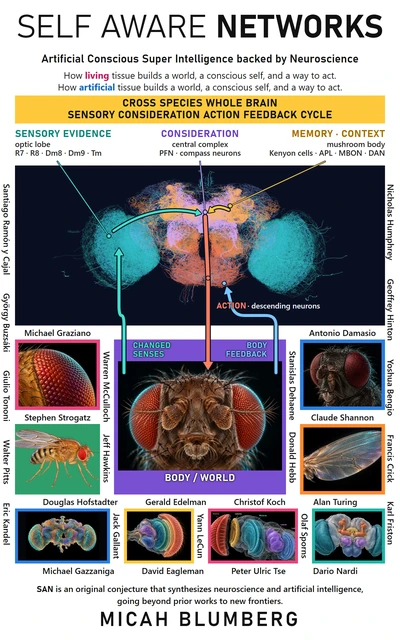
41 Cycles · Illustrated · Companion research Atlas
Get the Kindle edition · Explore the book at the Research Institute
Cover brain rendering adapted from FlyWire Consortium under CC BY 4.0.The public index connects every title to both its Zenodo record and OSF PDF. Readers can move from an overview to the provider copy of a paper without relying on this biography as evidence.
The collection spans neuroscience and consciousness, physics and mathematics, computational systems, research methods, and the bridges among them. The index is searchable by title and keeps the provider record one click away.
Building Sentient Beings, co-authored by Micah Blumberg and Michael S. P. Miller, is available on ResearchGate. Ramesh Yerramsetti discussed the paper in a December 2, 2025 LinkedIn article alongside systems including Soar, ACT-R, OpenCog, and ICOM.
The public record shows a continuous progression from web development and applied neurotechnology to publishing, community leadership, original research, AI systems, and spatial products.
Client web development, JavaScript and interactive media, NeoMindCycle, neurofeedback, and early BCI experimentation.
Founded SVGN, expanded science-tech reporting, began building spatial-media systems, and launched the Neural Lace Podcast.
Led NeurotechSF, brought EEG signals into WebXR, hosted neuroscience and coding events, and developed advanced A-Frame interfaces.
Developed the Synaptic Unreliability bridge, made SAN/NAPOT public through the 2022 GitHub release, expanded consciousness and physics research, and published the 2024 neuroscience book.
Built and maintain the public research index, expanded SIT/SDT and computational programs, and developed SAN Book 2 alongside a founder-led program connecting research tools, knowledge systems, spatial publishing, and education.
Human values at the center
I believe powerful technology should help people understand more, create more, and participate more fully. The best systems preserve context, reveal their sources, respect human judgment, and make difficult knowledge accessible without making it shallow.
Bring a research question, a manuscript, or an idea for an interactive experience. We can define a focused project around your audience and the result you need.
Turn a difficult question into a source-linked evidence map, a comparison of explanations, and a focused next-step plan.
Discuss a research projectShape a manuscript, research collection, or media archive into a navigable publication or reader prototype for your audience.
Discuss a publishing projectExplore a focused browser-based exhibit or product-story prototype, with the audience, target devices, and project scope agreed at the start.
Discuss a spatial demoDevelop an audience-specific session connecting AI, neuroscience, science communication, or building interactive experiences.
Discuss a talk or workshopStart with a short, non-confidential outline: your question or project, intended audience, desired outcome, shareable source material, and target timing. The email links open a draft in your mail app for you to review and send.